




Hi there! How can we help you today?
Combustion & Burner Maintenance Services
-
Home
-
Combustion & Burner Maintenance Services


Combustion & Burner Maintenance Services
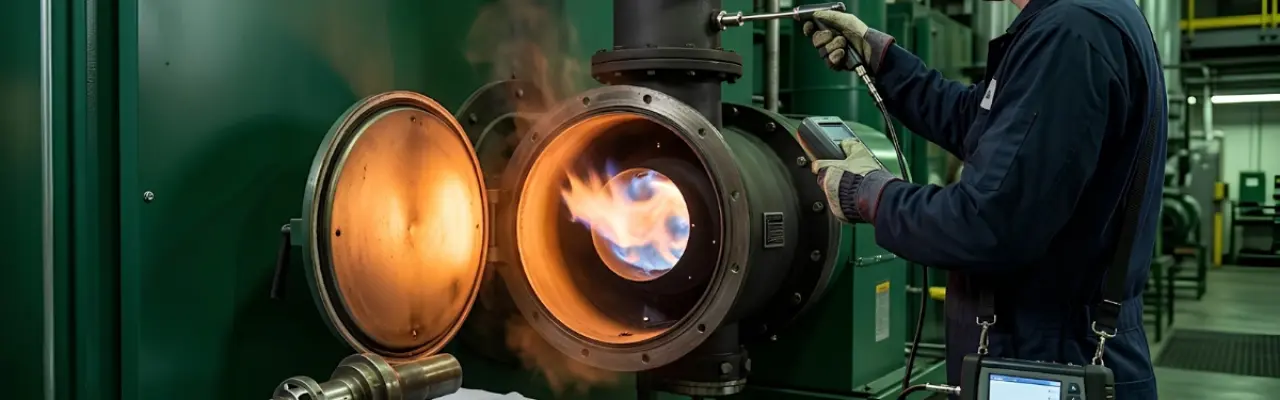
Poor combustion is one of the most common — and most costly — sources of energy waste in any process facility. An incorrectly tuned burner running with excessive air or a fouled nozzle can silently add 5 to 15 percent to your fuel bill while simultaneously increasing emissions and accelerating heat transfer surface fouling. At Dhyami Industrial Solutions, we provide professional combustion tuning, burner servicing, and flue gas analysis for steam boilers and thermic fluid heaters — restoring combustion efficiency, reducing fuel consumption, and keeping your burner running reliably between service intervals.
- Burner nozzle cleaning & replacement,
- Flame scanner & UV sensor servicing,
- Air-fuel ratio tuning & optimisation,
- Flue gas analysis & combustion efficiency report,
- Ignition electrode inspection & alignment,
- Fuel train pressure & filter inspection
What Poor Combustion Costs You
A high stack temperature is the clearest sign that heat is leaving your system unrecovered — usually caused by soot on the fire-side, excess air in the flue, or a fouled heat transfer surface. Every 10°C rise in stack temperature above design typically costs around 0.5 percent in fuel efficiency. Multiply that across thousands of operating hours and the cost is significant. Our combustion tuning service identifies and corrects every factor driving that loss — systematically, with data.
Flue Gas Analysis
We conduct full combustion analysis — measuring O2, CO, CO2, and stack temperature — to identify excess air, unburnt fuel, and combustion inefficiency with precision.
Burner Nozzle & Scanner Service
Burner nozzles, flame scanners, UV sensors, and ignition electrodes are cleaned, inspected, and replaced as required — eliminating the most common causes of flame failure and repeated lockout.
Air-Fuel Ratio Optimisation
We tune the air-fuel ratio to the optimum point for your specific fuel type and firing rate — minimising excess air, reducing stack losses, and maximising combustion efficiency.
How We Work
- We begin with a full combustion performance assessment — measuring current O2, CO, CO2, and stack temperature using a calibrated flue gas analyser to establish the baseline before any adjustments are made.
- The burner is isolated and fully inspected — nozzle tips, atomiser, air register, flame scanner, UV sensor, ignition electrodes, and fuel train are checked against OEM specifications.
- Fouled or worn components are cleaned or replaced — burner nozzle, flame scanner, and ignition electrodes are the most common causes of repeated flame failure and lockout events.
- The air-fuel ratio is tuned systematically — starting from the manufacturer's recommended settings and adjusted based on live flue gas readings until combustion efficiency is optimised for the specific fuel and firing rate.
- A post-tuning flue gas analysis is conducted and compared against the baseline — confirming the improvement in O2 percentage, CO reduction, and stack temperature reduction achieved.
- A full combustion service report is provided — documenting pre-tuning and post-tuning flue gas data, components serviced or replaced, and recommendations for the next service interval.
Our service covers burner nozzle cleaning and replacement, flame scanner and UV sensor inspection, ignition electrode alignment, air-fuel ratio tuning, fuel train pressure and filter inspection, and a full flue gas analysis with pre and post-tuning combustion efficiency report.
Key indicators include rising fuel consumption for the same steam or heat output, black or smoky exhaust, repeated flame failure lockouts, high stack temperature, soot deposits on tubes, or a high CO reading on flue gas analysis. Any of these symptoms warrants immediate investigation.
Yes. We service gas-fired, light oil, and heavy fuel oil burner systems — covering all common burner types used on steam boilers and thermic fluid heaters across industrial process facilities.
Results vary by system and current condition, but correctly tuned combustion typically delivers 3 to 10 percent fuel saving compared to a poorly adjusted system — by reducing excess air, eliminating unburnt fuel losses, and lowering stack temperature to near-design values.
For most industrial boilers and heaters, burner servicing is recommended at least annually — or every 2000 to 4000 operating hours depending on fuel type and firing rate. Systems burning heavy fuel oil typically require more frequent nozzle and atomiser servicing than gas-fired systems.
Every combustion service includes a full report documenting pre-tuning and post-tuning flue gas analysis results — showing O2 percentage, CO level, stack temperature, and calculated combustion efficiency — giving you a clear record of the improvement achieved.
Share this service: