




Hi there! How can we help you today?
Thermic Fluid Testing & Management Services
-
Home
-
Thermic Fluid Testing & Management Services


Thermic Fluid Testing & Management Services
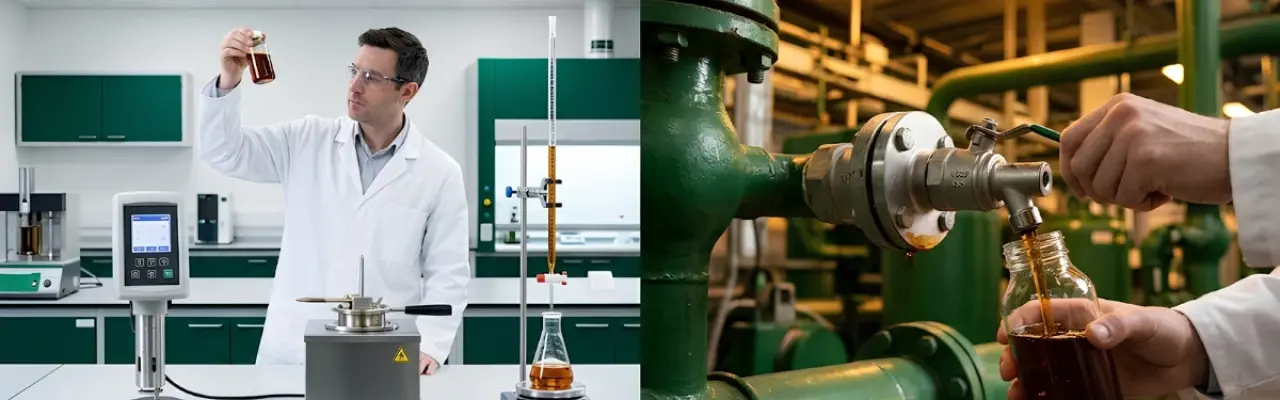
Thermic fluid degradation is invisible until it is expensive. By the time coking deposits appear on the heater coil or the fluid turns dark and thick, significant damage has already occurred. At Dhyami Industrial Solutions, we provide structured fluid sampling, laboratory testing, and health management services that track your fluid condition over time — catching degradation trends early, preventing coil fouling, and extending fluid life across every operating cycle.
- Periodic fluid sampling from live system,
- Laboratory testing — viscosity, flash point & TAN,
- Carbon residue & colour analysis,
- Trend reporting against baseline values,
- Fluid replacement & top-up recommendations,
- Compatibility verification for top-up fluids
Why Fluid Testing Cannot Be Skipped
A single data point tells you very little — it is the trend that matters. Rising viscosity combined with increasing carbon residue points to thermal cracking and heavy-end formation. A falling flash point signals dangerous light-end accumulation. Rising Total Acid Number indicates oxidation is underway. Our structured testing programme tracks all these parameters against your fluid's baseline — giving you the earliest possible warning before fouling, coking, or fire risk develops.
Lab-Tested. Trend-Tracked.
Every fluid sample is tested for viscosity, flash point, TAN, and carbon residue — results trended against baseline values to identify degradation before it causes fouling or failure.
Early Warning. Zero Surprises.
We identify viscosity drift, TAN rise, and flash point drop at the earliest stage — long before they cross the hard limit and cause coil fouling, pump problems, or fire risk.
Fluid Replacement Guidance
When test results indicate the fluid has reached end-of-life, we advise on safe draining, system flushing, compatible replacement fluid selection, and correct recommissioning procedure.
How We Work
- We establish a baseline fluid test report at the start of the programme — sampling your current fluid and testing all key parameters to create a reference point for all future trend analysis.
- Fluid samples are collected at agreed intervals — typically every 6 months or per fluid manufacturer recommendation — from the correct system sample point under operating conditions.
- Each sample is laboratory tested for viscosity, flash point, Total Acid Number, carbon residue, and colour — results compared against the baseline and the fluid manufacturer's in-service limits.
- A clear trend report is provided after every test — showing parameter movement over time, early warning flags, and specific recommended actions before limits are reached.
- If oxidation is detected, we assess nitrogen blanketing integrity and recommend corrective action — addressing the root cause rather than simply noting the symptom.
- When fluid replacement is required, we advise on safe system draining, correct flushing procedure, compatible replacement fluid selection, and proper recommissioning to protect the new charge.
- All test reports and recommendations are documented and retained — building a complete fluid history record that supports maintenance planning and AMC reviews.
We test viscosity, flash point, Total Acid Number, carbon residue, and colour — the four most critical parameters for tracking thermal degradation, oxidation, and contamination in thermic fluid systems. Results are trended against your fluid's original baseline specification.
Most fluid manufacturers recommend sampling every 6 to 12 months under normal operating conditions — more frequently if the system runs at high bulk temperatures or has a history of oxidation or contamination. Our team recommends the correct interval for your specific fluid and operating profile.
A rising TAN is a clear sign of oxidative degradation — typically caused by air or oxygen ingress through an unsealed or poorly blanketed expansion tank. Left unaddressed, it leads to sludge and varnish formation, filter blockage, and corrosive attack on system components.
Fluid replacement is recommended when viscosity, TAN, flash point, or carbon residue cross the fluid manufacturer's published in-service limits — or when trend analysis shows a consistent drift that will reach those limits before the next scheduled test. We advise on timing based on actual test data, not fixed time intervals.
Yes. We can sample and test fluid from any thermic fluid system regardless of the fluid brand or heater manufacturer — providing test results and recommendations referenced against the specific fluid manufacturer's published in-service specifications.
Yes. We supply OEM-specified or manufacturer-recommended replacement thermic fluid — and advise on the correct system flushing procedure before charging the new fluid to prevent contamination of the fresh charge.
Share this service: