



What are you looking for?

Explore our services and discover how we can help you achieve your goals

Manufacturing Trends

  1. Home

  2. Manufacturing Trends

Background image

Where Indian Manufacturing Is Headed

Manufacturing Trends Shaping Indian Industry

Indian manufacturing is evolving faster than at any point in recent decades, driven by rising energy costs, tighter competition, and growing pressure to reduce downtime and improve output consistency. Plants that once relied purely on manual oversight are now investing in automation, predictive maintenance, and energy-efficient equipment to stay competitive. As a supplier working closely with plants across multiple sectors, Dhyami Industrial Solutions observes these shifts directly through what industries are sourcing and why.

By the Numbers

  • 5+ Trends Tracked Across Sectors
  • 20+ States of Demand Observed
  • 3 Core Drivers (Cost, Uptime, Compliance)
  • Growing Share of Automation-Related Orders

Where Demand Is Shifting

  • Automation & Control Adoption — 82%
  • Energy-Efficient Motors & Drives — 74%
  • Predictive & Preventive Maintenance — 70%
  • Consolidated Vendor Sourcing — 62%
  • Sustainability-Linked Procurement — 50%

Key Manufacturing Trends Worth Watching

These are the shifts most consistently showing up in procurement patterns and plant investment decisions across the sectors Dhyami serves.

  1. Rising Adoption of Automation & Control Systems — More plants are moving from manual monitoring to PLC- and SCADA-based control, driven by the need for consistent output and reduced human error.
  2. Energy Efficiency as a Procurement Priority — Energy-efficient motors, VFDs, and soft starters are increasingly specified upfront rather than treated as optional upgrades, as electricity costs weigh more heavily on operating budgets.
  3. Shift Toward Predictive & Preventive Maintenance — Plants are moving away from reactive repair toward scheduled inspection and condition monitoring to avoid costly unplanned downtime.
  4. Consolidation of Vendor Relationships — Procurement teams are increasingly favoring suppliers who can cover multiple equipment categories, reducing the overhead of managing dozens of specialized vendors.
  5. Compliance & Documentation Expectations Rising — Buyers are asking for material certification, test reports, and traceability more consistently than in the past, reflecting tighter internal audit and export requirements.

What This Means for Plant Procurement Teams

  • Equipment specification is increasingly tied to lifecycle cost, not just upfront price.
  • Suppliers who can support both product sourcing and maintenance are gaining preference over single-transaction vendors.
  • Automation-readiness is becoming a factor even in routine equipment replacement decisions.
  • Documentation and compliance support are now a baseline expectation, not a premium ask.

How Dhyami Supports Plants Navigating These Trends

  1. Cross-Category Sourcing — Access to valves, pumps, motors, drives, and automation components through one supplier, aligned with the vendor consolidation trend.
  2. Energy-Efficient Equipment Options — Guidance toward energy-efficient motor and drive selections where lifecycle cost matters more than upfront price alone.
  3. Maintenance & AMC Support — Preventive maintenance and AMC coverage that align with the industry's shift away from reactive repair.
  4. Documentation on Request — Compliance and test certification provided to meet growing internal audit and traceability expectations.

Built on Watching the Market, Not Just Selling Into It

Understanding where manufacturing demand is heading allows Dhyami to stock and recommend equipment that matches where plants are actually investing — not just what has historically sold. This is reflected in growing automation, energy-efficiency, and maintenance-related enquiries across our customer base.

Tags: Automation-Ready Sourcing | Energy-Efficient Options | Preventive Maintenance Aligned | Pan-India Insight | Compliance Documentation

Common Questions About Manufacturing Trends

Is automation only relevant for large-scale manufacturers?
No, automation scales to fit the application — smaller plants are increasingly adopting basic PLC-based control for specific processes rather than full plant-wide systems.

How much can energy-efficient motors actually reduce operating costs?
Savings vary by application and duty cycle, but energy-efficient motors and properly sized VFDs typically reduce electricity consumption meaningfully in continuous-duty operations compared to standard motors run at fixed speed.

Why are more plants consolidating their vendor relationships?
Managing fewer, more capable suppliers reduces coordination overhead, simplifies accountability, and often improves consistency in product quality and delivery timelines.

Does Dhyami provide guidance on which trends apply to a specific plant?
Yes, our team can review your current equipment and processes to suggest where automation, efficiency, or maintenance improvements would have the most practical impact.

Get a Quote From Our Team

Manufacturing Trends in India | Dhyami Industrial Solutions

Explore key manufacturing trends shaping Indian industry - automation, energy efficiency & smart maintenance - insights from Dhyami Industrial Solutions.
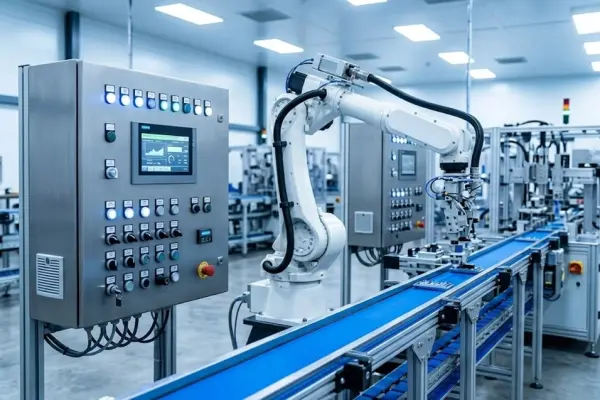
Top 5 Industrial Automation Trends Shaping Manufacturing in 2026
Industrial Insights Top 5 Industrial Automation Trends Shaping Manufacturing in 2026

A look at the top automation and control system trends transforming manufacturing plants — from smar...

Dhyami Industrial Solutions
Stay updated

Subscribe to our Newsletter!

Join 52,000+ people on our newsletter
Dhyami Industrial Solutions
Live Chat Offline

Hi there! How can we help you today?

Powered by FOB Live Chat
