



Hi there! How can we help you today?
Pump Selection Guide
-
Home
-
Pump Selection Guide

Choose Right the First Time
Pump Selection Guide — How to Choose the Right Pump for Your Application
Selecting the wrong pump is one of the most common and costly mistakes in industrial procurement — leading to energy waste, premature failure, or a system that simply can't deliver the flow your process needs. This guide, based on Dhyami Industrial Solutions' experience supplying pumps across water, chemical, and industrial applications, walks through the key factors that determine correct pump selection.
By the Numbers
- 4 Key Selection Factors
- 10+ Pump Types Compared
- 20+ States Supported With Selection Advice
- 95% First-Time Correct Fit Rate
What Affects Pump Selection Most
- Flow Rate & Head Requirement — 90%
- Fluid Type & Viscosity — 82%
- Chemical Compatibility — 75%
- Operating Temperature — 65%
- Duty Cycle (Continuous vs. Intermittent) — 58%
Key Factors to Consider Before Choosing a Pump
Getting pump selection right isn't guesswork — it comes down to a handful of technical factors that, once known, narrow down the right pump type and size quickly.
- Flow Rate & Total Head — Determine how much fluid needs to move (flow rate) and how much resistance the pump must overcome (total head), as these two factors define your pump's duty point.
- Fluid Type & Viscosity — Water, chemicals, slurries, and viscous fluids each require different pump designs — a centrifugal pump suited for water may not handle a thick slurry effectively.
- Chemical Compatibility — Wetted parts must be made from materials that won't corrode or degrade on contact with your specific fluid, whether that's cast iron, stainless steel, or a specialty alloy.
- Duty Cycle & Operating Conditions — Continuous-duty applications demand more robust construction than intermittent-use pumps, affecting motor sizing and material selection.
Common Pump Types and When to Use Them
- Centrifugal Pumps — Best for high-flow, low-to-medium head applications like water transfer and general process fluids.
- Diaphragm Pumps — Suited for handling abrasive, viscous, or shear-sensitive fluids at lower flow rates.
- Dosing & Metering Pumps — Used where precise, controlled fluid volumes are required, such as chemical dosing.
- Gear & Screw Pumps — Effective for high-viscosity fluids like oils and lubricants.
- Submersible Pumps — Designed for borewell, dewatering, and sewage applications where the pump operates fully submerged.
- Hydraulic Pumps — Used to generate pressure for hydraulic power systems rather than general fluid transfer.
How Dhyami Helps With Pump Selection
- Share Your Application Details — Provide fluid type, required flow rate, head, and any chemical or temperature considerations.
- Get an Expert Recommendation — Our team reviews your requirement against pump curves and material compatibility data to recommend a suitable model.
- Compare Options if Needed — If more than one pump type could work, we outline the trade-offs so you can decide based on cost, efficiency, or maintenance preference.
- Order & Ongoing Support — Once you've selected a pump, we handle sourcing, dispatch, and after-sales support including spares and seal replacements.
Built on Technical Accuracy & Consistency
Correct pump selection prevents the two most common failure modes in the field — energy waste from oversizing and premature failure from undersizing or poor material match. Dhyami's selection guidance draws on real application data across water, chemical, and industrial process installations to help you avoid both.
Tags: Flow & Head Matched Selection | Material Compatibility Checked | Genuine Product Guarantee | Pan-India Logistics | Technical Support Included
Common Questions About Pump Selection
How do I calculate the head my pump needs to overcome?
Total head includes static lift (vertical distance the fluid must be raised), friction losses in piping, and any pressure requirement at the discharge point — our team can help calculate this from your system layout.
What happens if I choose an oversized pump?
An oversized pump wastes energy, can cause excessive wear from operating away from its best efficiency point, and may require additional flow control equipment to manage output.
Can one pump type handle multiple fluid types?
Some pump types are more versatile than others, but fluid viscosity, solids content, and chemical compatibility usually determine whether a single pump model is suitable across different fluids.
Does Dhyami help select pumps for both new projects and replacements?
Yes, our selection guidance applies equally to new system design and to replacing an existing pump that isn't performing as expected.
Pump Selection Guide - How to Choose | Dhyami Industrial Solutions
Learn how to select the right industrial pump - flow rate, head, fluid type & material considerations explained by Dhyami Industrial Solutions experts.
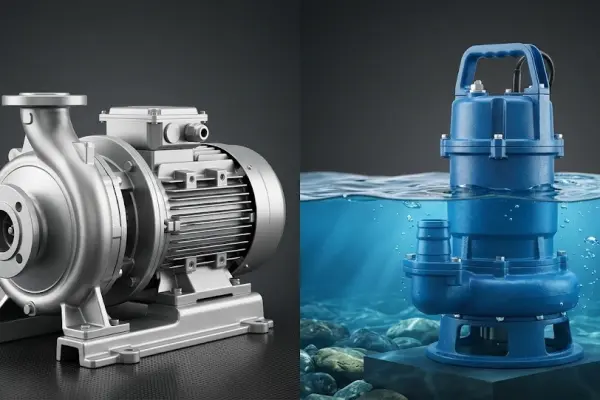
A detailed comparison of centrifugal and submersible pumps — working principle, use cases, pros, con...